
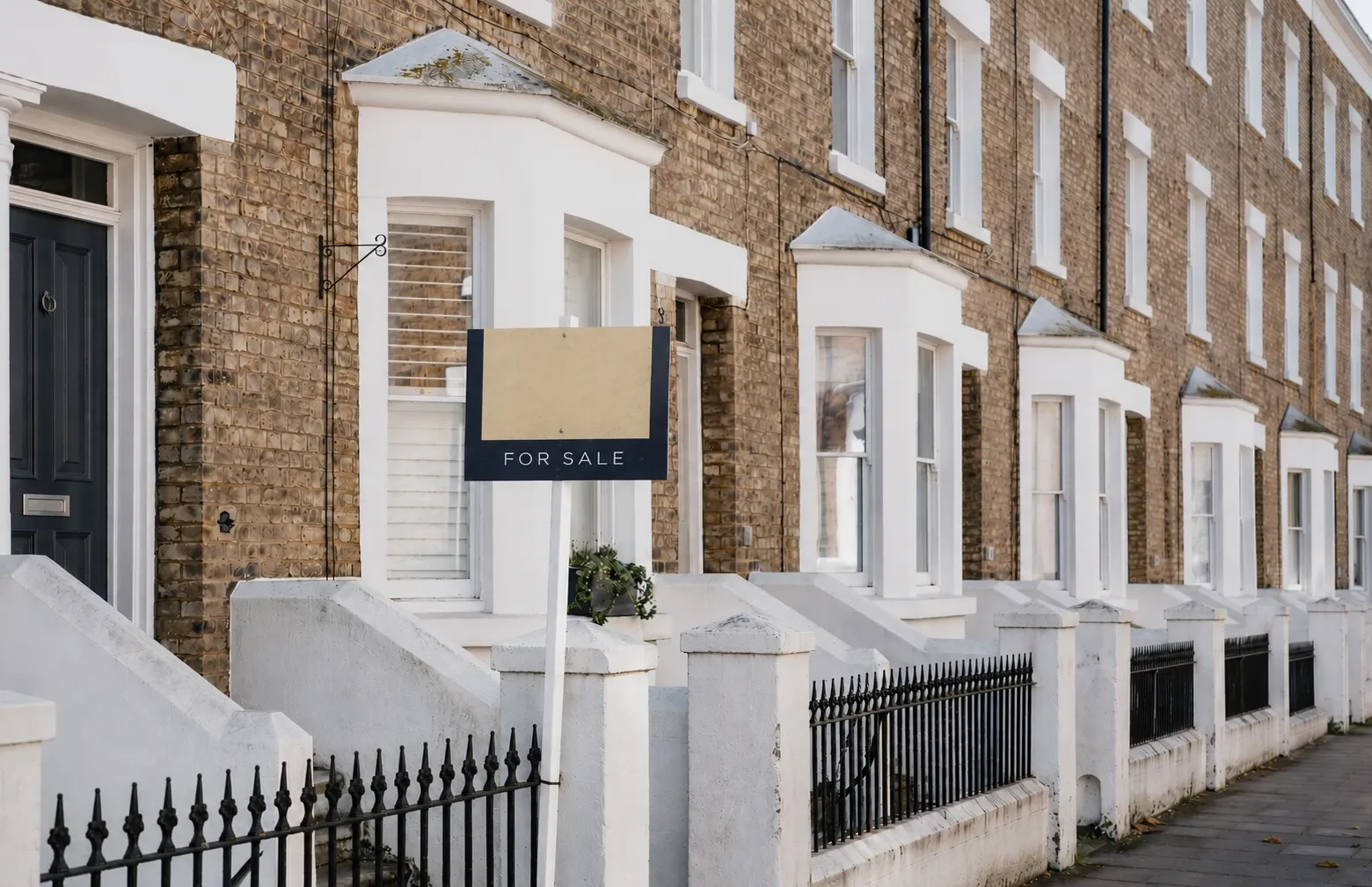
Most London buyers start with the same thought: five years minimum, maybe longer, possibly forever. Then life gets involved. A job changes, a relationship changes, the flat starts feeling smaller, and suddenly the For Sale board is back outside.
So how long do Londoners really stay before selling? I pulled every repeat sale on the same property from HM Land Registry, narrowed to homes that resold between 2015 and 2026, and measured the gap to the previous sale for every borough and ward in London.
The headline: the typical London home sold in the last decade had been held for 10.09 years, but the range across the city is wide. In the fastest regeneration pockets the median resale comes in under five years. In the stickiest outer suburbs it is close to twelve.
HM Land Registry records every property sale in England and Wales going back to 1995. Each property is mapped to a unique identifier, so when the same home sells more than once I can line up the transactions and measure the gaps.
For this piece I focused on London resales where the most recent transaction happened between 2015 and 2026 - essentially asking “for the homes that have changed hands in the last decade, how long had the previous owner held them?”. For each property I averaged the gap between consecutive sales, then took the median across all properties in each borough or neighbourhood.
The London-wide median came out at 10.09 years, which is the benchmark used throughout the charts.
Two things to keep in mind. Inheritance, divorce transfers and corporate restructures all show up as “sales” in the data. And newer buildings can only show short holds: a 2018 flat hasn’t had the chance to be held for ten years yet.
Distribution of years between consecutive sales (London, all repeat-sale properties)
The peak sits at years 4 and 5 (around 7.2% of repeat sales each), with the curve falling steadily after that. About 1.05% of properties resell inside a year of the previous sale: the house-flipper and off-plan-investor tail, much smaller than the borough headlines might suggest. Roughly 20% of recent resellers had held the home for 17 years or more, and a long tail stretches all the way out to 30 years.
Strip out the sub-1-year flips and the London median barely moves: from 10.09 → 10.18 years. That 0.09-year shift tells you flipping exists but explains almost none of the city-wide pattern. Most homes that changed hands in the last decade had been owned for around ten years.
Across the 32 boroughs plus the City of London, the medians run from 8.63 years in Lambeth at one end to 11.92 in Harrow at the other. A 3.3-year spread is much wider than people usually expect, and the geography is not random.
London borough turnover vs the London median (10.09 years)
The faster-moving boroughs cluster in inner south and east London, the regeneration belt:
The slow end is a more eclectic mix than the old “outer London hangs on” cliché:
The pattern is less inner-vs-outer than it used to be. The fastest tier is dominated by regeneration zones in inner south and east London. The slowest tier mixes outer suburbs with prime central. Everything else sits in the middle.
Full borough table
| Borough | Median turnover (years) | vs London median (years) | vs London median (%) |
|---|---|---|---|
| Lambeth | 8.63 | −1.46 | −14.5% |
| Hackney | 8.70 | −1.39 | −13.8% |
| Wandsworth | 9.03 | −1.07 | −10.6% |
| Tower Hamlets | 9.05 | −1.04 | −10.3% |
| Lewisham | 9.08 | −1.01 | −10.0% |
| Southwark | 9.22 | −0.87 | −8.6% |
| Islington | 9.30 | −0.79 | −7.8% |
| Greenwich | 9.46 | −0.63 | −6.2% |
| Haringey | 9.57 | −0.52 | −5.2% |
| Waltham Forest | 9.74 | −0.35 | −3.5% |
| Hammersmith and Fulham | 9.79 | −0.30 | −3.0% |
| Merton | 9.80 | −0.29 | −2.9% |
| Richmond upon Thames | 9.90 | −0.19 | −1.9% |
| Camden | 9.95 | −0.14 | −1.4% |
| Bromley | 10.00 | −0.09 | −0.9% |
| Newham | 10.00 | −0.09 | −0.9% |
| Kingston upon Thames | 10.07 | −0.02 | −0.2% |
| Croydon | 10.29 | +0.20 | +2.0% |
| Sutton | 10.36 | +0.27 | +2.7% |
| Bexley | 10.59 | +0.50 | +5.0% |
| Havering | 10.67 | +0.58 | +5.7% |
| Barnet | 10.71 | +0.62 | +6.1% |
| Brent | 10.76 | +0.67 | +6.6% |
| Hounslow | 10.78 | +0.69 | +6.8% |
| Ealing | 10.88 | +0.79 | +7.8% |
| Hillingdon | 11.09 | +1.00 | +9.9% |
| Westminster | 11.18 | +1.09 | +10.8% |
| Kensington and Chelsea | 11.65 | +1.56 | +15.5% |
| Redbridge | 11.66 | +1.57 | +15.6% |
| Barking and Dagenham | 11.75 | +1.66 | +16.5% |
| City of London | 11.77 | +1.68 | +16.7% |
| Enfield | 11.80 | +1.71 | +16.9% |
| Harrow | 11.92 | +1.83 | +18.1% |
The borough spread is wide. At neighbourhood level, it opens up further. The fastest wards in London turn over in under four years; the slowest are above fifteen.
Top 20 fastest-turnover neighbourhoods vs the London median
The dominant pattern is new builds, regeneration sites and flat-heavy markets. Some of that is mechanical (these wards literally haven’t existed long enough to show long holds). Some of it is behavioural (off-plan buyers are more often investors than people settling in).
| Neighbourhood | Borough | Median turnover (years) | vs London median (years) | vs London median (%) |
|---|---|---|---|---|
| Nine Elms | Wandsworth | 3.42 | −6.67 | −66.1% |
| Stratford Olympic Park | Newham | 4.75 | −5.34 | −52.9% |
| Woodberry Down | Hackney | 5.75 | −4.34 | −43.1% |
| Wembley Park | Brent | 5.79 | −4.30 | −42.6% |
| Bromley South | Tower Hamlets | 6.43 | −3.66 | −36.3% |
| Lewisham Central | Lewisham | 6.47 | −3.62 | −35.9% |
| Colindale South | Barnet | 6.64 | −3.45 | −34.2% |
| Canning Town South | Newham | 6.74 | −3.35 | −33.3% |
| Greenwich Peninsula | Greenwich | 6.79 | −3.30 | −32.8% |
| Kidbrooke Village & Sutcliffe | Greenwich | 6.80 | −3.30 | −32.7% |
| North Walworth | Southwark | 7.03 | −3.06 | −30.3% |
| Camberwell Green | Southwark | 7.07 | −3.02 | −29.9% |
| Evelyn | Lewisham | 7.08 | −3.01 | −29.8% |
| Lansbury | Tower Hamlets | 7.21 | −2.88 | −28.5% |
| Finsbury Park | Islington | 7.24 | −2.86 | −28.3% |
| St George’s | Southwark | 7.32 | −2.77 | −27.5% |
| East Greenwich | Greenwich | 7.34 | −2.76 | −27.3% |
| Greenwich Creekside | Greenwich | 7.41 | −2.69 | −26.6% |
| Brixton North | Lambeth | 7.52 | −2.57 | −25.5% |
| Stratford | Newham | 7.65 | −2.44 | −24.2% |
At the other end, people simply do not move as often. These are corners of London where buyers put down roots and supply stays tight.
Bottom 20 slowest-turnover neighbourhoods vs the London median
Outer north-west London (Harrow, Brent’s older wards, Hillingdon) dominates the slow list, alongside outer east (Redbridge, Bexley) and a handful of established central pockets. If you want the part of London where people put down roots, start there.
| Neighbourhood | Borough | Median turnover (years) | vs London median (years) | vs London median (%) |
|---|---|---|---|---|
| Kenton West | Harrow | 15.87 | +5.78 | +57.3% |
| Wembley Central | Brent | 15.19 | +5.10 | +50.5% |
| Tokyngton | Brent | 14.58 | +4.48 | +44.4% |
| Welsh Harp | Brent | 14.52 | +4.43 | +43.9% |
| Clayhall | Redbridge | 14.42 | +4.32 | +42.9% |
| Waterloo & South Bank | Lambeth | 14.39 | +4.30 | +42.6% |
| Longbridge | Barking and Dagenham | 14.19 | +4.10 | +40.6% |
| Newbury | Redbridge | 14.14 | +4.05 | +40.1% |
| Kenton East | Harrow | 14.05 | +3.96 | +39.2% |
| Pinkwell | Hillingdon | 14.04 | +3.95 | +39.1% |
| Thamesmead Moorings | Greenwich | 13.94 | +3.85 | +38.2% |
| Jubilee | Enfield | 13.86 | +3.77 | +37.4% |
| Goodmayes | Redbridge | 13.84 | +3.75 | +37.2% |
| Northwick Park | Brent | 13.80 | +3.71 | +36.8% |
| Belmore | Hillingdon | 13.72 | +3.63 | +36.0% |
| Heathrow Villages | Hillingdon | 13.69 | +3.60 | +35.7% |
| Regent’s Park | Westminster | 13.63 | +3.54 | +35.1% |
| Thamesmead East | Bexley | 13.61 | +3.52 | +34.9% |
| Kenton | Brent | 13.60 | +3.51 | +34.8% |
| Rayners Lane | Harrow | 13.57 | +3.48 | +34.5% |
The geography story is only half of it. The other half is the type of home. Splitting the same repeat-sale data by tenure, property type and new-build status surfaces patterns the borough map hides.
Median turnover by tenure vs the London median (10.09 years)
Leaseholds, overwhelmingly flats in London, change hands noticeably faster than freeholds. That fits the market: leasehold flats are smaller, more often a first rung on the ladder, and more often bought as investments. Freeholds skew towards houses people keep for longer.
| Tenure | Median turnover (years) | vs London median (years) | vs London median (%) |
|---|---|---|---|
| Leasehold | 9.01 | −1.08 | −10.7% |
| Freehold | 11.40 | +1.31 | +13.0% |
Median turnover by property type vs the London median
Flats turn over fastest, detached houses turn over slowest. The ordering: Flat < Terraced < Semi-detached < Detached, is basically the size-and-life-stage ladder. The flat is the starter home, the detached house is the destination.
| Property type | Median turnover (years) | vs London median (years) | vs London median (%) |
|---|---|---|---|
| Flat / Maisonette | 9.00 | −1.09 | −10.8% |
| Terraced | 10.74 | +0.65 | +6.4% |
| Semi-detached | 12.23 | +2.14 | +21.2% |
| Detached | 12.55 | +2.46 | +24.4% |
Median turnover for new builds vs existing stock
Homes whose first recorded sale was as a new build resell more than two years faster than the rest of the stock. Some of that is mechanical: new builds can’t have a long hold yet. A lot of it is behavioural: off-plan buyers are disproportionately investors, and the first owner-occupier is often a second-cycle buyer already thinking about the next move.
| Stock | Median turnover (years) | vs London median (years) | vs London median (%) |
|---|---|---|---|
| New build | 8.40 | −1.69 | −16.7% |
| Existing stock | 10.46 | +0.37 | +3.7% |
Turnover speed tells you something a listing won’t: what kind of owner base you’d be joining.
1. Fast turnover = investor / first-time buyer territory. If the median resale in your prospective new-build cluster is under 7 years, you are probably looking at a place dominated by short-term holders. That changes the feel of a building or neighbourhood:
2. Slow turnover = limited supply, but stickier prices. A neighbourhood where the median home sells every 12+ years has naturally limited supply. When a good house comes up, it tends to attract a queue. These are the streets where “I had to offer £30k over asking just to be considered” stories come from.
3. The “right” turnover depends on what you want.
A typical resold home in Nine Elms had been held for 3.42 years. In Kenton West, it had been held for 15.87 years. That is a 4.6× gap inside the same city, on the same dataset, measured the same way.
A few caveats before you take any of this too literally:
The absolute numbers will move a bit with stricter filtering, but the shape is stable. Inner south and east London regeneration zones turn over fast; outer north-west London, outer east London and a few established central pockets hold on longest.
The typical London home sold in the last decade had been held for 10.09 years. Lambeth is the fastest borough (8.63), Harrow the slowest (11.92). At neighbourhood level, Nine Elms turns over every 3.42 years and Kenton West every 15.87. That is a 4.6× gap inside the same city.